Nicotine Salts: Chemical Structure, Thermal Behaviour, and Device Compatibility
Technical Review: This article was reviewed and updated in February 2026 to reflect current formulation practices, device compatibility, and the regulatory context in Ireland.
Nicotine salts are a contemporary e-liquid formulation defined by chemistry, physics, and regulation. In 2026, their relevance is determined by molecular structure, thermal behaviour, and compliance with Irish and EU frameworks rather than lifestyle narratives.
Definition: A nicotine salt is nicotine combined with an organic acid (most commonly benzoic or salicylic acid), forming a protonated compound with lower pH and modified thermal characteristics compared to freebase nicotine.
Molecular structure and protonation
Nicotine salts are created by protonating the nicotine molecule with a weak organic acid. This lowers the pH of the solution and alters aerosol formation during heating. Lower pH is used as a formulation parameter to stabilise nicotine and optimise performance in compact systems.
Thermal behaviour and evaporation range
Nicotine salts vaporise efficiently at lower temperatures than freebase nicotine. This aligns with small coils and low-power operation, enabling consistent aerosol generation without high wattage.
Compatibility with pod systems
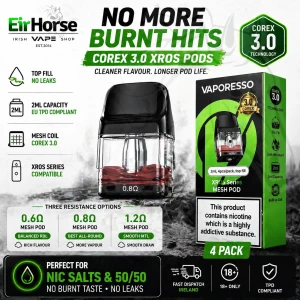
Low-power pod systems (typically 10–15 W) are engineered around higher-resistance coils and limited airflow. Nicotine salt formulations are optimised for this environment, balancing viscosity, thermal demand, and aerosol output.
Regulatory compliance in Ireland (TPD 2026)
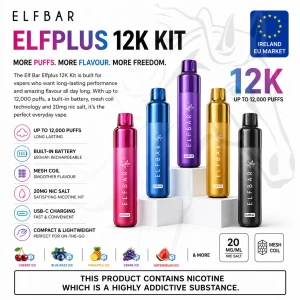
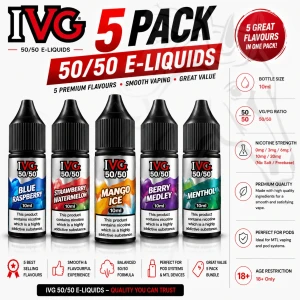
In Ireland and across the EU, nicotine salt e-liquids are regulated under TPD requirements. As of 2026, products must not exceed 20 mg/ml nicotine concentration and are limited to 10 ml refill bottles. Oversight and market control are administered by national authorities.
Official references: HPRA – Tobacco and Vaping Products · HSE – Vaping Regulation and Compliance
Excise duty impact (EPT)
Since November 2025, Ireland applies an excise duty on e-liquids based on volume. At €0.50 per millilitre, a standard 10 ml nicotine salt bottle carries a fixed excise component, reinforcing compliance and traceability within the legal market.
Tax reference: Revenue – Tobacco Products Tax (E-liquids)
Delivery characteristics: smooth delivery vs throat hit
The lower pH of nicotine salts results in smoother aerosol delivery at higher nicotine concentrations compared to freebase formulations. This description refers to chemical and physical behaviour, not to health outcomes.
Ingredient control and prohibited substances
Modern nicotine salt formulations sold in Ireland are manufactured without diacetyl and other substances withdrawn under HPRA guidance. Ingredient selection is driven by regulatory compliance and analytical verification.
Technical FAQ
What differentiates nicotine salts chemically from freebase nicotine?
Nicotine salts are formed by protonating nicotine with an organic acid, producing a compound with lower pH and altered thermal behaviour.
Why are nicotine salts paired with high-resistance coils?
Their lower vaporisation temperature aligns with small coils operating at lower power.
Are nicotine salts compliant with Irish regulations?
Yes. Products must comply with TPD limits of 20 mg/ml nicotine and 10 ml bottle size in Ireland.
Intent discloser
This article is technical and educational. It does not provide medical advice, health claims, or smoking cessation guidance.