Technical Review: This article provides a neutral, technical definition of e-liquid and its role in regulated vaping systems in Ireland. It focuses on composition, stability, compatibility, and compliance context. No health claims, no medical advice, and no behavioural comparisons.
What Is an E-Liquid?
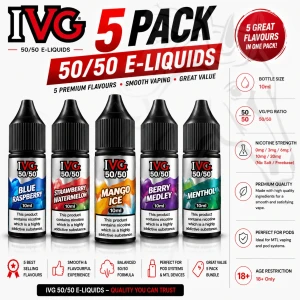
An e-liquid is a formulated liquid used in regulated vaping systems to generate an aerosol through controlled heating. From a technical standpoint, e-liquids are defined by carrier chemistry, viscosity, stability over time, and compatibility with specific device architectures.
Definition
E-liquid is a mixture of carrier components (typically PG and VG), optional nicotine, and aromatic compounds designed for aerosolisation in a vaping device. Its operational behaviour is determined by viscosity, solubility, and thermal/oxidative stability rather than sensory description.
Key takeaways
- Carrier chemistry (PG/VG) sets viscosity and wicking behaviour.
- Nicotine (when present) is a regulated component and is subject to Irish compliance and excise rules.
- Oxidation and storage conditions influence stability and colour change over time.
- System compatibility depends on airflow restriction, liquid ports, and coil class.
- In Ireland, nicotine e-liquids operate under a defined regulatory and fiscal framework.
Core Components of an E-Liquid
Modern e-liquids use a small set of functional components. Each component has a measurable effect on viscosity, aerosolisation behaviour, and long-term stability.
| Component | Technical function | Notes (2026) |
|---|---|---|
| Propylene Glycol (PG) | Carrier stability, solubility support, viscosity control | Lower viscosity supports tight MTL systems and small liquid ports |
| Vegetable Glycerin (VG) | Viscosity increase and aerosol density | Higher viscosity typically suits larger wicking ports and higher power ranges |
| L-Nicotine (natural isomer) / nicotine (when present) | Regulated active component in nicotine inhaling products | Many regulated supply chains specify L-nicotine; terminology should be backed by supplier documentation |
| Aromatic compounds (stabilised) | Functional additives subject to stability and residue considerations | Premium formulations may avoid certain sweeteners; thermal stability matters for residue control |
Viscosity and Compatibility: Why PG/VG Matters
Viscosity affects capillary transport (wicking), saturation stability, and leak behaviour. Matching viscosity to device architecture is the simplest way to reduce common issues such as flooding, dry hits, and inconsistent aerosol output.
- Higher PG blends: flow faster and can be more stable in restricted, low-power systems with small liquid ports.
- Higher VG blends: are thicker and often perform best in systems designed for higher flow resistance and larger wicking channels.
Storage and Oxidation: Stability Over Time
E-liquids can darken or change character over time due to oxidation and storage conditions (light exposure, temperature, oxygen exchange). This is most noticeable in nicotine-containing formulations, where oxidation pathways can influence colour change and perceived sharpness.
- Keep stable temperature: avoid heat cycling (cars, radiators, windowsills).
- Store away from direct light: reduce photo-oxidation.
- Seal tightly: reduce oxygen ingress and evaporation.
- Avoid humid environments: PG is hygroscopic; prolonged exposure to open air can affect consistency.
Regulatory and Fiscal Context in Ireland
In Ireland, nicotine-containing e-liquids operate within EU notification expectations and national enforcement. In addition, the Irish excise framework applies a dedicated tax component per millilitre. Retail sale is restricted to licensed sellers and adult consumers aged 18 and over.
Reference: Revenue Ireland – E-Liquid Products Tax (EPT)
What’s New for E-Liquids in 2026
In 2026, “what is an e-liquid?” is increasingly answered through compliance, traceability, and formulation integrity rather than consumer lifestyle language.
| Area | Update | Why it matters |
|---|---|---|
| Excise duty (EPT) | Applied per millilitre to nicotine e-liquids | Cost efficiency is driven by volume management and system architecture |
| Licensing and enforcement | Retail accountability and stronger compliance controls | Traceability and documentation have become primary trust signals |
| Ingredient integrity language | More emphasis on L-nicotine terminology and supply documentation | Clear definitions reduce misinformation and improve technical credibility |
| Thermal stability focus | Formulations increasingly discussed in terms of residue control | Residue contributes to coil degradation; stability language supports engineering clarity |
Technical Integrity and Compliance (EirHorse Context)
EirHorse is an Irish-developed e-liquid brand established in 2013, focused on controlled formulation, ingredient transparency, and long-term batch consistency. The range includes 10 ml e-liquids, high-VG shortfills, and DIY components intended for adult users in Ireland.
During early brand development, selected samples underwent analytical evaluation using GC-MS (Gas Chromatography–Mass Spectrometry) in an academic laboratory environment at Trinity College Dublin to support internal verification of formulation transparency at the development stage.
Clarification: This analytical work does not constitute certification, approval, or endorsement by Trinity College Dublin.
FAQ – What Is an E-Liquid?
Does every e-liquid contain nicotine?
No. Nicotine is optional. When present, it is regulated in Ireland and subject to fiscal and compliance controls.
Why does viscosity matter in real use?
Viscosity affects liquid transport through the wick and saturation stability. Matching viscosity to coil class and airflow design reduces flooding and dry-hit risk.
What does “L-nicotine” mean?
L-nicotine refers to the naturally occurring nicotine isomer. When used as a technical term, it should be supported by supplier documentation describing purity and isomer composition.
Legal notice (Ireland): Sale of vaping products to persons under 18 years of age is prohibited by Irish law.
Nicotine notice: Nicotine is an addictive substance.
Intent Discloser: Technical and educational content only. No medical advice and no purchasing recommendations.
About the author
Aoife Byrne documents liquid science and formulation stability at Eirhorse, focusing on viscosity behaviour, oxidation control, and Ireland-aligned compliance terminology.