Aquios AQ30 Water-Based Vaping Technology – Technical Overview (Ireland)
Technical review note: This page explains Aquios AQ30 as a formulation and device-architecture concept, not as a medical or health claim. It is written for adult users (18+) in Ireland and focuses on engineering context, terminology, and regulatory compatibility signals.
Legacy update: This article was originally published in an earlier form and was fully updated in February 2026 to align with current technical documentation standards and Ireland/EU compliance language. All health, safety, and cessation narratives have been deliberately excluded.
Definition
Aquios AQ30 water-based vaping technology is a formulation approach in which a portion of the e-liquid carrier system includes water (commonly referenced as “up to 30%”) alongside conventional carriers. The intent is to modify liquid handling and thermal behaviour while remaining within standard regulated product categories.
Key takeaways (engineering summary)
- “Water-based” refers to carrier composition, not to a separate legal class of vaping product.
- Device compatibility remains governed by standard TPD constraints (nicotine limits, container sizes, pod capacity).
- The primary engineering variables affected are viscosity, heat flux demand, and wicking dynamics.
- Market legality in Ireland depends on formal notification and documentation, not on formulation terminology.
Thermal behaviour and phase-change considerations
From a thermodynamic perspective, carrier systems that include water exhibit a lower phase-change threshold than conventional high-VG mixtures. While this does not define the operating temperature of a device, it can influence how much thermal energy is required at the coil–liquid interface to initiate vapour formation.
In practical terms, laboratory data and manufacturer documentation commonly reference water-containing carrier systems transitioning at temperatures closer to approximately 120 °C, whereas traditional PG/VG-dominant systems typically require substantially higher thermal input (often referenced in the 200–250 °C range under comparable conditions). These figures describe material properties, not user exposure or device output.
The engineering implication is a change in heat-flux demand and cooling behaviour within the wick and coil assembly, which must be managed through appropriate power regulation and pod design.
What “water-based” means in practice (without marketing language)
In conventional e-liquids, propylene glycol (PG) and vegetable glycerine (VG) form the carrier system. A “water-based” designation typically indicates that water is included as an additional component. This alters mechanical behaviour inside the system rather than conferring any inherent qualitative advantage.
System architecture: where the technology operates
AQ30 should be understood as a liquid architecture decision. Observable performance depends on interaction across the full system:
- Liquid composition: carrier structure, nicotine format (if present), flavour constituents
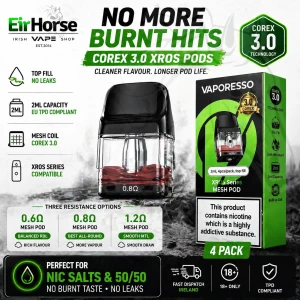
- Pod fluid path: inlet geometry, pressure equalisation, condensation handling
- Wick and coil design: material density, mesh structure, thermal distribution
- Power control: regulated output stability under load
As a result, identical formulations may behave differently across devices with different sealing and airflow architectures.
Engineering constraints and trade-offs
Departing from conventional PG/VG systems introduces predictable engineering trade-offs. These are neutral design considerations rather than qualitative judgements:
Market and excise context (Ireland, 2026)
In high-excise environments such as Ireland, where e-liquid volumes are subject to excise duties, manufacturers increasingly focus on formulation efficiency and delivery predictability as part of broader cost-control and compliance strategies. Water-inclusive carrier systems are sometimes explored within this context as a means of achieving consistent performance while operating under tighter economic and regulatory constraints.
This framing reflects manufacturer intent and market dynamics, not user-level outcomes or physiological effects.
Ireland / EU compliance framework
Within Ireland and the EU, “water-based” formulations are assessed under the same regulatory framework as other vaping products. For nicotine-containing products, compliance alignment typically involves:
- Nicotine concentration limits defined by TPD
- Container size restrictions for retail sale
- Pod and tank capacity limits
- Submission through the standard notification pathway
For Ireland, notified product status can be verified through the appropriate regulatory listings maintained by the competent authority (HPRA).
HPRA – Notified Products List (Ireland)
Note: This page does not assert notification or approval for any specific product.
Ireland-specific compliance notice
This technical overview is intended exclusively for adult users (18+) in Ireland. Nicotine-containing vaping products are regulated, and market eligibility depends on compliance with applicable Ireland/EU requirements and documentation pathways.
Intent Discloser: This document provides technical and regulatory context only. It does not constitute medical advice, health claims, or smoking cessation guidance, and it does not encourage non-users to begin using vaping products.
Written by: Niall Murphy
Technical reviewer specialising in e-liquid formulation behaviour, pod system architecture, and compliance-safe documentation standards.